
Two straight infinitely long current-carrying wires are kept along the $z-$axis at the coordinates $(0, a, 0)$ and $(0, -a, 0)$ respectively, as shown in the figure. The current in each wire is equal and directed along the negative $z-$axis (into the plane of the paper). The variation of the magnetic field on the $x-$axis will be approximately:
- A
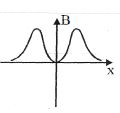
- B
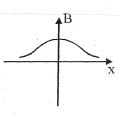
- C
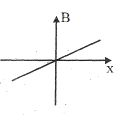
- D
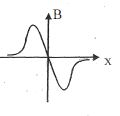
Explore More
Similar Questions
Consider a long straight wire of a circular cross-section (radius $a$) carrying a steady current $I$. The current is uniformly distributed across this cross-section. The distances from the centre of the wire's cross-section at which the magnetic field [inside the wire,outside the wire] is half of the maximum possible magnetic field,anywhere due to the wire,will be
What will be the resultant magnetic field at the origin due to four infinite length wires? If each wire produces a magnetic field '$B$' at the origin.
Difficult
View SolutionTwo concentric coils each of radius equal to $2\pi \, cm$ are placed at right angles to each other. $3 \, A$ and $4 \, A$ are the currents flowing in each coil respectively. The magnetic induction in $Wb/m^2$ at the centre of the coils will be $(\mu_0 = 4\pi \times 10^{-7} \, Wb/A \cdot m)$.
MediumAIIMS 2008
View SolutionTwo identical long conducting wires $AOB$ and $COD$ are placed at a right angle to each other,with one above the other such that $O$ is their common point. The wires carry currents $I_1$ and $I_2$,respectively. Point $P$ lies at a distance $d$ from $O$ along a direction perpendicular to the plane containing the wires. The magnetic field at point $P$ will be:
Difficult
View SolutionConsider two thin identical conducting wires covered with very thin insulating material. One of the wires is bent into a loop and produces a magnetic field $B_1$ at its centre when a current $I$ passes through it. The second wire is bent into a coil with three identical loops adjacent to each other and produces a magnetic field $B_2$ at the centre of the loops when a current $I/3$ passes through it. The ratio $B_1 : B_2$ is
DifficultJEE MAIN 2014
View SolutionVedclass Products
For Students
Vedclass Test Series
Mock tests in real JEE/NEET style with performance analysis. 5-day free trial.
Start Free TrialFor Teachers
Exam Paper Generator
Generate Set A/B/C/D exam papers from 7.5L+ questions in 2 minutes. 3 chapters free.
Try FreeFor Institutes
Online Exam Module
Live online exams with unlimited students, 360° analytics & white-label branding.
See Demo