
Class 11Physics3-2.Motion in PlaneDynamics of circular Motion (Centrifugal force) and Pendulum and Motion on Curved path
Difficult$A$ dancer moves counterclockwise at a constant speed around the path shown below. The path is such that the lengths of its segments,$PQ, QR, RS$,and $SP$,are equal. Arcs $QR$ and $SP$ are semicircles. Which of the following best represents the magnitude of the dancer's acceleration as a function of time $t$ during one trip around the path,beginning at point $P$?
- A
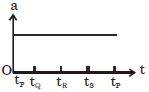
- B
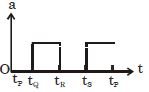
- C
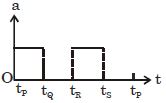
- D
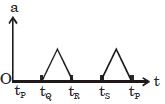
Explore More
Similar Questions
Two particles of mass $m$ are constrained to move along two horizontal frictionless rails that make an angle $2\theta$ with respect to each other. They are connected by a spring with spring constant $k$. The angular frequency of small oscillations for the motion where the two masses always stay at the same distance from the meeting point of the rails is:
Difficult
View Solution$A$ particle is moving with uniform speed along the circumference of a circle of radius $R$ under the action of a central fictitious force $F$ which is inversely proportional to $R^{3}$. Its time period of revolution will be given by
DifficultJEE MAIN 2021
View Solution$A$ ball of mass $0.25 \, kg$ attached to the end of a string of length $1.96 \, m$ is moving in a horizontal circle. The string will break if the tension is more than $25 \, N$. The maximum speed with which the ball can be moved is .......... $m/s$.
$A$ $500 \,kg$ car takes a round turn of radius $50 \,m$ with a velocity of $36 \,km/h$. The centripetal force is (in $\,N$)
DifficultAP EAMCET 2021
View SolutionThe $x$ and $y$ displacements of a particle are given as $x(t) = a \sin \omega t$ and $y(t) = a \sin 2 \omega t$. Its trajectory will look like:
DifficultJEE MAIN 2015
View SolutionVedclass Products
For Students
Vedclass Test Series
Mock tests in real JEE/NEET style with performance analysis. 5-day free trial.
Start Free TrialFor Teachers
Exam Paper Generator
Generate Set A/B/C/D exam papers from 7.5L+ questions in 2 minutes. 3 chapters free.
Try FreeFor Institutes
Online Exam Module
Live online exams with unlimited students, 360° analytics & white-label branding.
See Demo